
Eligibility for a Ration Card in Telangana: Who’s Excluded?
If you’re trying to get a ration card in Telangana, it’s important to know who cannot get one. A ration card provides households access to subsidized food grains and benefits under the EPDS Telangana (Electronic Public Distribution System). However, it is meant for those who genuinely need it, so not everyone qualifies based on the eligibility for a ration card in Telangana.
Eligibility Criteria and Exemptions for Ration Cards in Telangana
In Telangana, the eligibility for ration cards is determined based on specific criteria designed to ensure that those who truly need financial support have access to it. Below are the key factors that might make you ineligible.
People With Higher Household Income
In Telangana, there are income limits to ensure that ration cards go to lower-income families. The government wants to prioritize the families who need the most assistance, so those with higher incomes are generally not eligible for the benefits.
For families earning well above these limits, they will likely be ineligible for subsidized ration card benefits as they are considered to have sufficient means to support their needs.
Households Already Holding a Valid Ration Card
In Telangana, a family can only hold one active ration card at a time. If your household already possesses a valid ration card, you cannot apply for a second one under the same name or address.
This rule prevents households from taking advantage of multiple ration cards, which ensures the benefits are provided to those who truly need them, and maintains the integrity of the eligibility for a ration card in Telangana.
Non-Permanent Residents of Telangana
To apply for a ration card in Telangana, you must be a permanent resident of the state. You will need to provide strong proof of residency, such as utility bills or government-issued ID with your address, to confirm your eligibility.
If you are not able to show that you are a permanent resident or cannot verify your place of residence, your application may be rejected as part of the eligibility check for ration cards in Telangana.
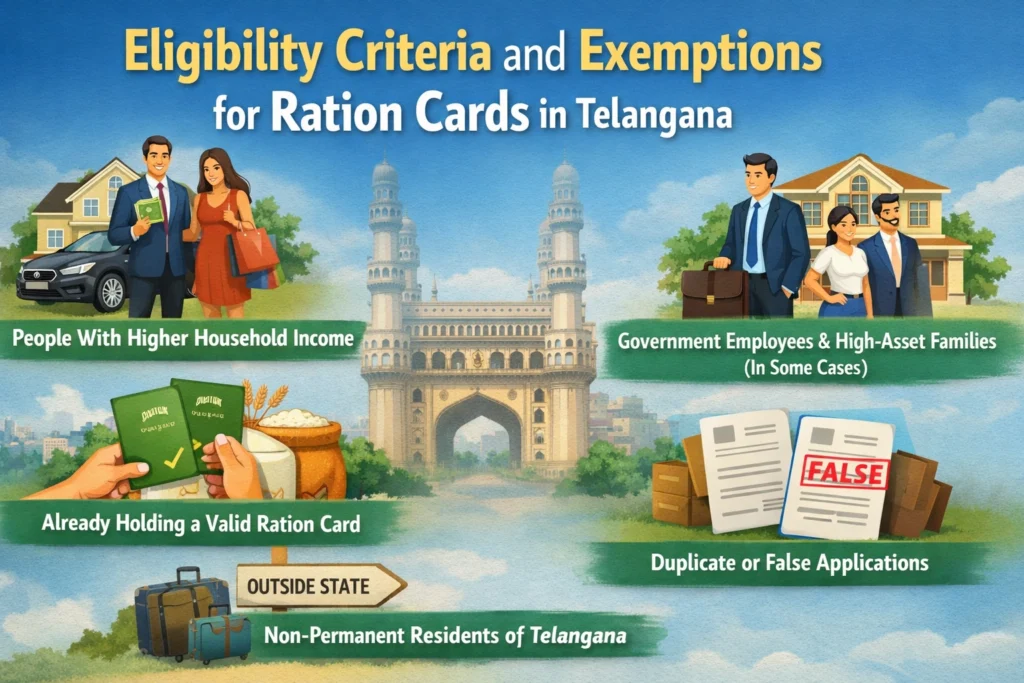
Government Employees and High-Asset Families (In Some Cases)
Certain eligibility guidelines suggest that households with government employees or significant assets may not be prioritized for subsidized ration cards. The system aims to provide benefits to those in need, so people with stable, well-paying jobs or significant wealth may be excluded from the benefits.
- Note: This rule may vary based on state policies and updates. Some government employees, depending on their income and assets, may still qualify, but high-asset families are often considered ineligible for ration cards as they may not meet the eligibility for a ration card in Telangana.
Duplicate or False Applications
The Telangana government has stringent measures in place to prevent fraudulent applications. If your application contains false information, such as fake income details, forged proof of residency, or incorrect identity documents, it will be rejected. Additionally, if a duplicate application is found (i.e., you or your family already have an existing ration card), your application will be disqualified.
How to Improve Your Ration Card Application Process
While the eligibility for a ration card in Telangana may limit who can receive a ration card, it’s important to ensure that your application process is smooth and successful. Here are some detailed tips to improve your chances of approval:
Check your income:
If your annual family income exceeds the state limits, delay your application until your situation changes. In some cases, your income may decrease, making you eligible in the future.
Provide correct address proof:
Telangana officials are very strict about verifying residency. Make sure to provide authentic, verifiable address proof, like your Aadhaar card, utility bills, or rent agreement.
Avoid errors on forms:
Mistakes on your ration card application can lead to rejection. Double-check all your personal details, income, and address before submitting your application. Missing or incorrect details can cause delays or disqualification.
Reapply if rejected:
If your application is rejected unfairly, don’t worry! You can always correct any mistakes, update documents, and submit a fresh application. Be sure to resolve the issue that led to the rejection before reapplying.
By taking extra care in these areas, you increase the likelihood of your application being accepted.
Common Mistakes to Avoid During the Application Process
While submitting a ration card application may seem straightforward, several mistakes can cause delays or rejection. Here are the most common mistakes to avoid:
Incorrect or Incomplete Documentation
Submitting incorrect or incomplete documents can lead to the rejection of your application. Common issues include missing address proof, incorrect income certificates, or not providing necessary identification.
To avoid this, ensure that you have all the required documents prepared before submitting your application, including:
Not Checking Eligibility Before Applying
Many applicants make the mistake of not verifying their eligibility before submitting their application. This can lead to wasted time and effort, especially if your income exceeds the state limits or if you already possess a valid ration card.
Before submitting the application, check:
Summary of Eligibility for a Ration Card in Telangana
| Not Eligible For Ration Card If… | Why |
|---|---|
| Your family income is above the limits | Not seen as needing subsidized support |
| You already have a current ration card | One card per household rule |
| You aren’t a Telangana resident | Cards are for state residents |
| You provided wrong info or duplicates | System checks authenticity |
| You have high‑asset status (government job, etc.) | Priority is for economically weaker groups |
Frequently Asked Questions
Final Thoughts
Applying for a ration card in Telangana comes with specific eligibility for a ration card in Telangana that aim to ensure that the system reaches those who truly need it. It’s crucial to follow the guidelines, provide accurate information, and verify your residency before submitting an application.
If you’re ineligible, don’t be discouraged — keep track of your situation and reapply when circumstances change. Keep an eye on updates from local authorities for any policy changes that might affect your eligibility.


